blog

why represent

This post riffs off of a recent prompt by the Journal of Architectural Education for the Spring 2025 Issue. Below is a portion of the prompt “extracted” from the full Call for Papers. Full CFP is linked here.

Architecture extracts. The term extraction derives from the Latin extrahere, meaning “to draw out,” “to drag out,” “to remove.” While extraction has been occurring for thousands of years, colonialism and global capitalism have together accelerated the removal and commodification of physical and non-physical resources, defining our current systems of extractivism. Situating architecture’s relationship with—and beyond—the many forms of contemporary extractivism and extraction more broadly, this issue reimagines this condition of ‘drawing out’ in expansive and inclusive ways that challenge the geo-logics of extraction within design.
….
Drawing out — How do the tools of representation enable us to represent the spatial/ non-spatial forces of extraction, and what new modes of representation might allow for the transition to non-extractive practices?

Tools of Representation

  1. Something to write and draw with
  2. Something to write and draw on
  3. Something to measure the things being drawn
  4. Visual and written language to communicate what is being drawn

When thinking of extraction or non-extractive practices, it is not the pen that extracts, rather the person who is holding it. New modes makes me think of RULES of representation rather than the tools.

Rules of Representation

No tools should be made of materials that can harm the health of people or the land, or have been made with processes that result in harming people and the land

  1. The thing you use to write and draw with should be accessible to and usable by the people being represented
  2. The thing you use to write and draw on should be accessible to and editable by the people and places who are being represented
  3. The thing you use for measuring should be accessible and legible to anyone being represented or measured by the tools
  4. The visual and written language should be primarily in the language of the people’s being represented

What implications might this have? Especially for language? It means, you have to know the language first. It means, maybe, you shouldn’t be the one making the representation of a thing in the first place.

Because laptops, software, keyboard, mouse, and even the making of pencils and paper involve conflict minerals and extraction, this leaves out a lot of current practices. Which makes sense why current practices need to change. One of the most straightforward things that would not break the Rules of Representation is simply face-to-face communication. No recording, no podcasts, no notes – just day-to-day interactions. Spending time learning, eating, remembering, and talking of dreams. From there, you build.

Why do you need to represent a thing to someone who is there with you the whole time? To someone who shares the same experiences with you and is PRESENT? Much of the time, we use RE-presentations to show someone else a thing they have not experienced or seen themselves. It offers them a partial understanding of a thing that the person who made the representation deems as valuable or worth recording. This is already the first step of extraction. It reduces the thing to what the re-presenter deems worth representing. Even if it’s a photo.

You can never enclose the wholeness of a place or a person to a representation without taking something or “drawing out” what is deemed worthy of drawing. Even if the thing is not physically taken or extracted, if shown to others, it has now shaped their views of this thing they do not know. It has stolen the opportunity for the thing to speak for itself. It’s like being shown the spoilers of a TV show or video game content that has been data-mined and not yet released.

So what now? Do we just stop attempting to represent anything? No – and nothing is perfect or pure in this world. We do the best we can. We think of ways that follow the Rules of Representation. What if the thing you use to draw is made from the pigment found from the safer minerals of that place and the canvas is a visible wall or square where people gather? Then maybe the measurement is something people of the place have always used or custom for its purpose like stones or seeds or how far a you can hear someone’s call?

Standard notations and measurements help with ex-change and ex-traction, but do we not exist outside of transactions? Not everything needs and can be an “equal” transaction. A dollar is the not the same to a person with billions and a person with none. An apple is not the same as an orange, and even if one requires more effort to grow, they may be appreciated the same by different people.

Since unlearning is hard and change is difficult in a world built from extraction, maybe the first step begins by knowing and re-presenting yourself and your community instead of writing about how to represent others.
prefigurative politics

Carl Boggs, a professor social science professor, coined this phrase to talk about how folks develop organizing methods and relationship structures that strive to embody the structures of the very society they are fighting for. I first heard of prefiguration in the context of prison abolition, and now I’m encountering it again as I read Dispersing Power: Social Movements as Anti-state Forces (2010): “The internal dynamic of social struggle weaves social relations among the oppressed, as a means of ensuring survival in the first place, both materially and spiritually… eventually, society takes the form of a sea of ‘new’ social relations…” (p. 4).

I think it’s a profoundly hopeful way to think about the world, because it makes hopes and wishes that much more real. From the smallest things like, I wish that I could have friendly relationships with my neighbors we could help one another out with groceries, to broader things like, I wish instead of the military and police we could rely on mediation, deescalation, and non-violent emergency coalitions to provide care and coordination necessary to negotiate conflicts. I know in many ways, places like these probably do exist in some way, but I wish it to be everywhere, like the “sea”, because at the end of the day, I just want everyone to have what they need and to be ok.

ancient-orchid-scripture

I looked up the definition of the Quran in Chinese. It’s 古兰经, pronounced Gǔlánjīng. As a Chinglish speaker, I’m always fascinated with the literal translations of characters. In this case, it’s literally “ancient orchid scripture” or “simple, graceful, experience”. I like the look up even down the radical sometimes even though I know some characters are simply phonetic. Honestly, it could all be phonetic, but Chinese has a language has always mixed up meanings with sounds. My therapist let me know about this app Pleco, which is great for looking up more in depth definitions as well as Cantonese pronunciations.

古 gǔ

old, ancient, but can also mean quaint, simple, or sincere (古朴)

兰 / 蘭 lán

orchid, or lily magnolia (Magnolia liliiflora native to Sichuan and Yunnan provinces), can also mean elegant or graceful (fun fact: same lan as Mulan from popular legends); if we look further into characters we have 艹 representative of plants or grass, 门 or 門 for door, and 柬 referring to card, note, or letter; the literal translations can sometimes make less sense as we get further into the radicals, but I like it for context

经 / 經 jīng

scripture, to experience or undergo, to endure; going by radicals, we have 纟for silk; 巛 for river; and 工 for work, labor, or craft

on fire, like water

“You’re on fire!” is metaphorically used to refer to someone who is doing very well usually in some kind of competition. “The world is on fire,” on the other hand, leans more heavily into the literal meaning of burning in the context of misfortune or disaster. “Fire” by itself can also refer to people’s passion and commitment. Recently, an active US military serviceman set himself on fire, literally, as a measure to stop the genocide of Palestinians and US complicity in it.

Somehow, I remain like water, maybe because I have to be – not to put out fires – but to keep myself from bursting into flame.

I am hopeful to be like water, even if sometimes I wish I was fire. I remember that water is life, and together, “We are waves of water against the walls oppressors built to try to control and contain us” (YK Hong, “We are Water”, 2023).

100 days of code

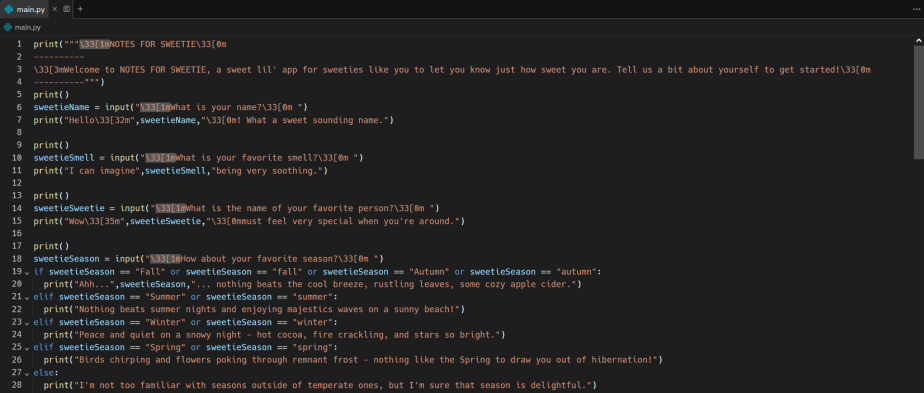
Have you ever heard of or tried 100 days of code? I started looking at this about 6 months ago, but took a break and am now revisiting it. It’s essentially 100 different exercises that gradually build your knowledge in a given programming language. I decided to start off with Python, using an online platform called replit. It’s been pretty engaging so far!

So far I’ve been able to code an affirmations generator (I called it “Notes for Sweetie” hehe) based on user input and also a compound interest calculator with user input on the amount of the money, annual interest rate, and number of years for at that rate. I don’t know how to actually show the code on a website yet, but when I get there I will show it! My hope is to be able to build interactive tools and platforms for community organizing and action.

balancing agency together

“Resonant games are also designed for learning with others. Paradigms like cognitive apprenticeship, communities of practice, and communities of learners emphasize not only learning by doing, but by doing things together with others, often in carefully designed activities that balance the agency and self-direction of learners with an egalitarian spirit that encourages all to learn and to learn together.”

–  Eric Klopfer, Jason Haas, Scot Osterweil, and Louisa Rosenheck, Resonant Games: Design Principles for Learning Games that Connect Hearts, Minds, and the Everyday, 2019, Chapter 2

I just attended the first class of Eric Klopfer’s Design and Development of Games for Learning at MIT (11.127)! I really hope I get to take the class – it’s completely over-enrolled, so it’s unlikely – but I’m excited about it regardless. The quote above is part of a book the instructor has co-authored, and it addresses exactly the type of game I am trying to design for my thesis!

Existing participatory design practices, aren’t fully collaborative nor participatory. The game I intend to develop will facilitate learning and achieving consensus with others, and “balance the agency” among players.

games irl

If we do not accept the wide-ranging and increasingly significant role that video games have in shaping the way people interact with city space, then we leave it open to conservative or reactionary portrayals of city life and space more generally.

– Charlie Clemoes / The Failed Architecture Team, #02 City Gameplay: The Influence of Video Games on Our Urban Experience, May 26, 2018, Failed Architecture, https://failedarchitecture.com/podcast/02-city-gameplay-video-games-and-their-influence-on-urban-life/

I listened to this podcast a friend of mine introduced me to, and it helped solidify my research endeavor into games as a landscape – or culture-creator. It’s not just interactions with cities that are impacted, but the way everyone works and lives every day, regardless of socioeconomic class or geographic location. Everything is impacted, and everything has to change. Games are just one underestimated medium of change.

exist

to say that you have some sort of disorder or that you’re confused? That’s not a Native perspective on gender expression… Hawaiians don’t come out: We simply exist.

– Kumu hula Hinaleimoana Wong-Kalu, “Above all else, I am kanaka.” Yes Magazine, no. 85 (Spring 2018), accessed March 17, 2018,  http://issues.yesmagazine.org/issue/decolonize/theme.html#13thArticle

People should not have to fit into some category of white, heteronormative, “scientific” invention. Difference intimates plurality, flows, multiple dimensions of time, and the re-imagining of space.

into my roots

It doesn’t matter how many pieces make up my whole; rather, it’s my relationship with those pieces that matters — and that I must maintain. Simply saying “I am this” isn’t enough. To truly honor my heritage, I found I must understand and participate in it.

– Kayla DeVault, “Native and European — How Do I Honor All the Pieces of Myself?” Yes Magazine, no. 85 (Spring 2018): accessed March 16th, 2018, http://issues.yesmagazine.org/issue/decolonize/theme.html#13thArticle.

I say I am Chinese-American, but I don’t even know what American means… except perhaps less Chinese. And less Chinese I certainly feel – illiterate and detached from my heritage.

There are everyday practices, small, aesthetic remarks, which are just poignant enough to stick in my brain. Using chopsticks, making dumplings, reusing plastic wrap, receiving red bags, and never leaving any food to waste lest the heavens strike me down. But having grown up in an urban center, drastically detached from the earth, I have not greeted nor tended the land – a land which I feel I have no right to be on.

While most of my elder relatives on my mother’s side reside in the northeastern parts of China, Héběi and Hénán, I recently found out that many of my ancestors were merchants of some kind from as far as what was Persia to the Uyghur lands of the Xīn Jiāng province in northwest China. I hope one day I can travel back to revive parts of my heritage that may have been lost as my ancestors found their ways to city centers, and then, to the United States.

It is my duty to delve deep, into my roots, to “understand and participate,” as Kayla DeVault aptly noted, in the traditions and relationships which have sustained my growth and germination. I must be critical and radical in my work to learn to give back and respect the earth.

re-value

Hypercapitalism [‘a system that celebrates materialism, consumption, and status’] depends for its very survival on materialistic values… The more that people and societies prioritize materialistic values, the less they care about promoting well-being, fair treatment of others, and environmental sustainability.

– Larry Gonick and Tim Kasser, Hypercapitalism, 2018, 3

The statement above may sound matter of fact, but it’s worth reiterating and one with radical implications. If capitalism depends on materialistic values, and we begin changing or eliminating these values altogether, this leads to the dismantling of the oppressive, racial capitalist system that we often claim to be impossible to unravel.

Critical values, intentions, and priorities are what often tip the balance in favor of empowerment over disempowerment. As a designer, I always need to be re-valuing, re-prioritizing, and re-designing for each context and community.