prefigurative politics

Carl Boggs, a professor social science professor, coined this phrase to talk about how folks develop organizing methods and relationship structures that strive to embody the structures of the very society they are fighting for. I first heard of prefiguration in the context of prison abolition, and now I’m encountering it again as I read Dispersing Power: Social Movements as Anti-state Forces (2010): “The internal dynamic of social struggle weaves social relations among the oppressed, as a means of ensuring survival in the first place, both materially and spiritually… eventually, society takes the form of a sea of ‘new’ social relations…” (p. 4).

I think it’s a profoundly hopeful way to think about the world, because it makes hopes and wishes that much more real. From the smallest things like, I wish that I could have friendly relationships with my neighbors we could help one another out with groceries, to broader things like, I wish instead of the military and police we could rely on mediation, deescalation, and non-violent emergency coalitions to provide care and coordination necessary to negotiate conflicts. I know in many ways, places like these probably do exist in some way, but I wish it to be everywhere, like the “sea”, because at the end of the day, I just want everyone to have what they need and to be ok.
ancient-orchid-scripture

I looked up the definition of the Quran in Chinese. It’s 古兰经, pronounced Gǔlánjīng. As a Chinglish speaker, I’m always fascinated with the literal translations of characters. In this case, it’s literally “ancient orchid scripture” or “simple, graceful, experience”. I like the look up even down the radical sometimes even though I know some characters are simply phonetic. Honestly, it could all be phonetic, but Chinese has a language has always mixed up meanings with sounds. My therapist let me know about this app Pleco, which is great for looking up more in depth definitions as well as Cantonese pronunciations.

古 gǔ

old, ancient, but can also mean quaint, simple, or sincere (古朴)

兰 / 蘭 lán

orchid, or lily magnolia (Magnolia liliiflora native to Sichuan and Yunnan provinces), can also mean elegant or graceful (fun fact: same lan as Mulan from popular legends); if we look further into characters we have 艹 representative of plants or grass, 门 or 門 for door, and 柬 referring to card, note, or letter; the literal translations can sometimes make less sense as we get further into the radicals, but I like it for context

经 / 經 jīng

scripture, to experience or undergo, to endure; going by radicals, we have 纟for silk; 巛 for river; and 工 for work, labor, or craft

100 days of code

Have you ever heard of or tried 100 days of code? I started looking at this about 6 months ago, but took a break and am now revisiting it. It’s essentially 100 different exercises that gradually build your knowledge in a given programming language. I decided to start off with Python, using an online platform called replit. It’s been pretty engaging so far!

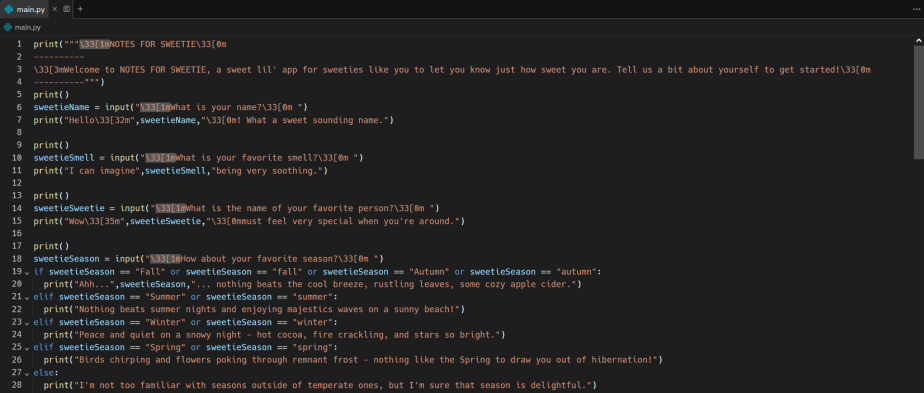
So far I’ve been able to code an affirmations generator (I called it “Notes for Sweetie” hehe) based on user input and also a compound interest calculator with user input on the amount of the money, annual interest rate, and number of years for at that rate. I don’t know how to actually show the code on a website yet, but when I get there I will show it! My hope is to be able to build interactive tools and platforms for community organizing and action.